
First prize in the essay competition: „How are Gödel’s conceptual and mathematical realism, his argument against the existence of time and his ontological argument compatible with a coherent ontology?“
Author: Cordelia Mühlenbeck
Gödel’s holistic ontology – the foundation of science on an exact theory of metaphysics
1) Introduction
Kurt Gödel’s scientific life’s work consisted in constructing a comprehensive system of the sciences on a fundamental metatheory that he described as an exact theory of metaphysics—positioned at the intersection of philosophy, mathematics, logic, and theology. In doing so, he was strongly guided by Leibniz’s monadology, as becomes clear from Hao Wang: „Gödel’s program in philosophy is to find an exact theory of metaphysics, presumably in the form of a monadology. […] Gödel characterized his philosophical outlook in this way: ‚[…] My theory is a monadology with a central monad (namely, God) [addition by Hao Wang]. It is like the monadology by Leibniz in its general structure. […] My theory is rationalistic, idealistic, optimistic, and theological.‘“ (Wang, 1997, p. 8) In addition to Leibniz, Gödel was strongly influenced by Husserl and saw Husserl’s phenomenology as the right path to affirm “the primacy of the mind” (Wang, 1997, p. 8)—and thereby an idealistic and rational perspective, one that also grounds the connection between our concepts in the form of mathematical ideas and their real effects (Wang, 1997, p. 8). The description as “optimistic” can be understood through Gödel’s division of worldviews into two sides: on the one hand, a turning away from metaphysics and religion, and on the other, a turning toward them. The latter corresponds to an orientation toward idealism and optimism, while the former—i.e., the turning away from metaphysics and religion—corresponds to an orientation toward skepticism, positivism, and empiricism, and thus toward materialism and pessimism (Gödel, 1961, p. 374). Leibniz’s monadology is structured such that everything—that is, the world and the individual entities in it—is built out of monads as the fundamental units (Leibniz, 1998, p. 11), which initially gives this overall constitution an atomistic appearance. But the cause and basic constituent of all monads is, in turn, the primordial monad—God—who is first of all of a spiritual nature (Leibniz, 1998, p. 37) and secondly described in detail as absolutely infinite (Leibniz, 1998, pp. 33-37), which is the most important feature for our discussion. Thus, absolute infinity is recognized as the fundamental ontology—i.e. as the basic component of the world—and is adopted by Gödel as the foundation of his exact metaphysics, as becomes clear from the above quotation. As we will see, this concept of absolute infinity will be the core characteristic that connects Gödel’s conceptual and mathematical realism with his work on the nature of space-time, his argument against the objective existence of time, and his ontological proof of God. We will later examine more closely what implications this concept has for the consideration of reality, also through the mathematical consequences it entails.
2) Gödel’s conceptual and mathematical realism
We will begin by examining Gödel’s general views on concept formation and, for this purpose, take a closer look at key elements of Husserl’s phenomenology, Gödel’s relation to it, and his views on mathematical intuition. He held that mathematical concepts are recognized, described, and justified through intuition (Bedürftig & Murawski, 2010, p. 16). He regarded this intuition as distinct from empirical perception and as a kind of additional sense, granting us access to an abstract world independent of spatiotemporal reality—one that represents the most general formal concepts and relations underlying the totality of specific spatiotemporal objects (Gödel, 1953, version III, pp. 353–354). In this way, mathematical intuition retains a connection to the real world, and it becomes clear that Gödel advocated a Platonic realism, or even took a critical distance from strict Platonism1 (Bedürftig & Murawski, 2010, p. 114). Gödel considered mathematics—like physics—to be based on axioms with real content (Gödel, 1944, p. 132), with mathematical statements being true by virtue of their concepts, which rely on intuition rather than merely following conventions (Gödel, 1953, pp. 357-358). In this context, his distinction between concepts such as “thing” or “entity” and “whole” or “unity” is significant because it plays a role in the principles of mathematics (the closure principle), particularly in set formation and organization (Wang, 1997, p. 295). With his completeness theorem of 1929 (the fundamental theorem of mathematical logic for a formal system of first-order predicate logic), Gödel demonstrated that classical logic suffices to derive all valid formulas of first-order predicate logic. In doing so, he critically engaged with intuitionistic mathematics, even with respect to his own methods of proof (Gödel, 1929, pp. 62–64). For Gödel, mathematical intuition had two aspects: On the one hand, it is connected to reality, since the laws of nature are mathematically formulated (Gödel, 1953, p. 360). On the other hand, it is necessary for grounding abstract, syntactic regularities (Gödel, 1953, p. 357). Mathematical objects are—unlike their representations in mathematical theories—of a transcendent nature, because axioms describe mathematical objectivity only incompletely. This is similar to Kant’s epistemology, but differs in that Gödel did not see the real structures as dependent on the knowing subject (Bedürftig & Murawski, 2010, p. 115). Instead, Gödel oriented himself more strongly toward Husserl’s phenomenology and believed that Husserl’s method could yield new mathematical concepts, particularly in the field of set theory (Bedürftig & Murawski, 2010, p. 116; Wang, 1997, pp. 156-157).
Husserl’s eidetic reduction, which grasps the essence of things through recursive intuition at higher levels of abstraction while bracketing subjective and theoretical presuppositions (Husserl, 2006, p. 222; 2013, p. 281), leads, according to Gödel, to the result that we all arrive at the same concepts (Gödel, 1944, and the accompanying commentary). However, there are different forms of concepts, as seen already in Husserl’s distinction between concepts arising from sensory experience and those stemming from logic. Not only general sensory perception, but every form of concept formation arises through figure-ground segregation (Mühlenbeck & Jacobsen, 2020; Mühlenbeck, Jacobsen, Pritsch, & Liebal, 2017; Mühlenbeck, Liebal, Pritsch, & Jacobsen, 2015, 2016), in which relevant information stands out from less relevant information, and through this differentiation shapes the content and properties of a concept. Since concept formation is structurally identical at every level, concepts differ only with respect to the content they concern (Mühlenbeck, 2022b). Thus, there are concepts with concrete content and others that grasp the essence of things or the conditions underlying them.2 This fact has implications for concept formation in mathematics, since we can grasp sets in different ways, as expressed in the notions of sets and classes. Husserl distinguished between pure logic, which deals with a priori valid laws and conditions as the foundation of any theory, and applied logic, which deals with mental contents (Husserl, 1900, chap. 2). Pure logic and mathematics hold independently of empirical consciousness, which corresponds to Gödel’s Platonic realism. With this distinction, Husserl criticized the psychological approach, since it emphasizes the subjectivity of cognition and thereby calls into question the objectivity of logical–mathematical content (Husserl, 1900, p. VII). Mathematical intuition thus enables insights into fundamental conditions that influence normative structures and reality. Husserl describes this connection through the concept of intentionality, which expresses the directedness of consciousness and the linkage of concepts with worldly content (Husserl, 1900, p. 101; 1988). In this way, different levels of abstraction can be apprehended—from concrete empirical objects to normative structures and the fundamental conditions underlying them.
2.1) Concepts of sets, points, and the continuum
When we apply these mechanisms of concept formation to mathematics, we arrive at Gödel’s work in set theory, its foundations, and his search for new concepts. Through the proofs regarding the continuum hypothesis by Gödel (1939) and Cohen (1963), it was shown that a secure ordering of the infinities cannot be established on the basis of the current axiomatic framework of set theory. For his 1939 proof sketch, Gödel used an inner model of set theory and the axiom of constructibility V=L, which states that the universe of all sets V is assumed to be identical to the universe of all constructible sets L. He then showed that within this model GCH (the generalized continuum hypothesis—and thereby also the continuum hypothesis, CH) holds and that if ZFC (Zermelo–Fraenkel set theory with the axiom of choice) is consistent then so is ZFC + CH. Later, Cohen (1963) constructed models using the forcing method, in which CH (and thus also GCH) is false, thereby demonstrating that CH is independent of ZFC—that is, neither CH nor its negation can be proven from the axioms of ZFC. Furthermore, Gödel’s incompleteness theorems (Gödel, 1931) refuted the secure, general consistency of the mathematical system (on the axiomatic basis of set theory ZF), meaning that for the current system there exists neither a final justification nor, due to the results concerning CH, a final ordering. In both areas—consistency as well as the ordering of sets—one encounters an infinite hierarchy of different infinities that can never be completely grasped by further set operations or formations.
With the construction of the universe of sets L, Gödel did not intend to create an alternative set theory but to develop an inner model in order to demonstrate the compatibility of ZF, the axiom of choice (AC), and the generalized continuum hypothesis (GCH) (Bedürftig & Murawski, 2010, p. 228). Contrary to what the axiom of constructibility suggests, he did not see the future of set theory in a restriction to definable sets but in an extension that also includes large cardinals and the power set axiom (Gödel, 1947, p. 520). He assumed that work on CH would lead to new axioms and eventually refute the hypothesis (Gödel, 1947, p. 524), and he argued that only an intuitionist could accept the independence of CH. Anyone who believes in an objective mathematical reality must assume that CH is either true or false, and that the known axioms (ZFC) are not sufficient to fully capture this reality (Gödel, 1947, p. 520).
Gödel’s results show that set theory can be continually extended by new axioms. Since the notions of a “set” and a “property of a set” are flexible, conceptual extensions may continuously generate new axioms, which in turn influence mathematical statements such as the continuum hypothesis—and the concepts and restricted domains of sets involved in them (Gödel, 1947, p. 520, fn. 17). Moreover, the existing axiomatic system is not complete: the very concept of a set suggests ongoing expansion, enabling ever higher stages of set formation and including large cardinal numbers. Such cardinals cannot be captured solely through standard operations such as forming power sets or unions. Gödel therefore advocated for new strong axioms of infinity3 to keep the universe of sets open, and regarded Mahlo-type axioms as particularly natural extensions of the existing theory (Gödel, 1947, p. 520).
The origin of the issues described lies in a central problem of early set theory: Russell’s antinomy showed that the set of all sets cannot exist, since it would have to contain itself as an element, thereby exceeding itself. Gödel and others resolved this problem by distinguishing between sets and classes: every set is a class, but proper classes are no longer sets4. The universal class V therefore remains a proper class that cannot be treated as a set. In von Neumann–Bernays–Gödel (NBG) set theory (Bernays, 1937, 1976; Gödel, 1940; Neumann, 1925, 1928), the formation of large sets is preserved, while the introduction of classes dissolves the antinomies, enables open structures, and establishes a different understanding of sets. Gödel argued that V, as the universe of all sets and a proper class, follows a principle of maximality from which the axiom of choice can be derived (Wang, 1997, p. 262). Thus, the order induced by the axiom of choice does not restrict the et-theoretic universe itself; rather, it exists within the not finally determinable universal class.
Furthermore, extensions of the set universe—such as those involving Mahlo or inaccessible cardinals—are possible not only outward, but also inward toward the infinitesimals (Bedürftig & Murawski, 2010, p. 187). In this way, we already see the feature of both internal and external unboundedness of the continuum, which we will develop further below. To do so, it is helpful to introduce a conceptual distinction: the homogeneous continuum may be understood as an indefinite — that is, inexhaustible and infinitely divisible (Bedürftig & Murawski, 2010, pp. 157, 174-175, 186)—absolute infinity, which we can take to correspond to the universal class, whereas the discrete point-continuum of sets5 represents the operations of set formation within the homogeneous continuum. Gödel’s incompleteness theorems, through the open-endedness of the axiomatic structure of mathematical systems, demonstrate that no ultimately structured mathematical totality can exist on the basis of currently available classical concepts—a result that is reflected in the distinction just described: between the set-theoretic notion of sets and the universal class as a proper class and absolute infinity.
The current undecidability of the continuum hypothesis supports this picture of an open infinity that cannot be fully structured, which Gödel referred to as a generalization of the closure principle (in connection with the Ackermann principle) (Wang, 1997, p. 281), as will be discussed in more detail in the following section. The difference—but above all the necessary dependence—between the two notions of the continuum defined above is clarified in more detail by Bedürftig and Murawski (2010, p. 186): today’s continuum is identified with the real numbers ℝ, yet as a set it possesses no intrinsic continuity. Points within this continuum are distinguishable only via the assignment of numbers or coordinates, which in turn are merely projections onto the continuum, not the continuum itself. It merely serves as the basis for such mappings, and paradoxically, what was originally supposed to be represented only through this foundation ultimately takes the place of the foundation itself (ibid.). This means that the discrete points of the real numbers depend necessarily on the homogeneous continuum and have no independent existence without it, even though they have now been placed in its position. Likewise, Gödel described the total system of set theory—which we have characterized as the homogeneous continuum—as a unified universe that does not fundamentally change when one passes from smaller to larger sets (Wang, 1997, p. 281). Absolute infinity can be captured neither by large cardinals nor by infinitesimals, since every set-theoretic operation is based on the concept of point sets.
From this arises the necessity of new concepts and axioms to address unresolved questions such as the continuum hypothesis—axioms of set theory “which a more profound understanding of the concepts underlying logic and mathematics would enable us to recognize as implied by these concepts” (Gödel, 1947, pp. 520-521). A concept of this new kind would, for example, provide a unifying notion of sets that not only encompasses the formal level of set formation, but simultaneously refers to its own meta-level of conditions and would thus lead toward the completeness of the entire system. In this sense, Gödel wrote in his notes “class (= absolute),” which Wang comments as follows: “I believe the word class here means the universal class (of all sets and individuals) and that the identification of this with the absolute harks back to an idea of Cantor’s”6 (Wang, 1997, p. 315). The distinction between homogeneous continua and discrete point sets reflects a deeper ontological relation: in ontology, the existential relation of every entity to its being—a relation that we also encounter in cognition and perception through figure–ground separation (see above and: Mühlenbeck, 2020, 2021, 2022a). In Gödel, this relation appears in both its subjective and objective aspects as the fundamental relation of causality (Gödel, 2024, pp. 56, 127; Kovač, 2015, 2020; Wang, 1997, p. 315). Objects, including those given in intuition, exist only through their constituting background, since they emerge from it and can thereby be distinguished and recognized. Analogously, the homogeneous continuum is infinitely divisible, and points can exist within it in intuition by emerging from it, whereas discrete points would constitute indivisible boundaries that, however, could have no existence of their own without an underlying continuum (Bedürftig & Murawski, 2010, p. 157).
Through this infinite divisibility—which is necessary for existence—absolute infinity is also reflected inwardly into the structure of sets. This necessary relation leads to Gödel’s call for new concepts and principles, such as the Ackermann and reflection principles (as maximality principles), which establish the relation between the different notions of sets. Thus, the absolute infinity of the set-theoretic universe is considered not merely an external magnitude but also an intrinsic property of every part of the structure—the very feature we already recognized earlier, in the analogy with the monadology, in the construction from the absolutely infinite primordial monad. This constitutes the essence of absolute infinity and distinguishes it from all other forms of infinity: namely the fact that every point itself must be absolutely infinite, because otherwise, if even a single point were finite, the given infinity would no longer be absolute.
2.2) New concepts and principles of maximality
The discrepancy described above between the homogeneous continuum and the poin continuum leads us to the general foundational controversy in mathematics, which arose primarily from the results of Gödel’s incompleteness theorems (Gödel, 1931), but also from the indeterminate resolution of the continuum hypothesis (Cohen, 1963; Gödel, 1939, 1940). As discussed earlier, Gödel held that only a new kind of mathematical concept could resolve this issue (Gödel, 1946, p. 151). He called for a new, comprehensive concept that already contains within itself the unbounded totality of the universal class in the sense of absolute infinity, the strong axioms of infinity, and the existing axioms of set theory (Gödel, 1946, p. 151). To understand this concept more precisely, we must look more closely at his description of the related principles of set theory. The reflection principle means, on the one hand, the possibility of reflecting a certain property of the class of all sets in individual sets, and on the other hand, the impossibility of fully capturing the universe of all sets (V) structurally, regardless of the logic used—even if that logic allows for arbitrarily large infinities (Wang, 1997, pp. 280-281). Gödel describes this as a generalization of the closure principle, meaning that the totality of all sets remains in a certain sense indescribable: “When you have any structural property that is supposed to apply to all sets, you know you have not got all sets. There must be some sets that contain as members all sets that have that property.” (Wang, 1997, p. 281) The closure principle clarifies that when a set V is considered closed with respect to certain operations, there will always exist another similar set that is likewise closed. Through the repeated application of such set-forming operations, inaccessible cardinals such as Mahlo cardinals arise (Wang, 1997, p. 280). This principle thus leads to the non-closure of V, because there exist sets that contain these closed sets as elements and yet extend beyond them. Gödel connects this idea with the Ackermann principle, which describes the undefinability of V as the Absolute: “Ackermann’s system is based on the idea of the indefinability of V, or the Absolute.” (Wang, 1997, p. 282) He regarded this principle as the foundation for all axioms of set theory: “All the principles for setting up the axioms of set theory should be reducible to a form of Ackermann’s principle: The Absolute is unknowable.” (Wang, 1997, p. 283) In this inherently unfinalizable possibility of structuring the Absolute, Gödel saw the reflection principle as the central and fundamental concept: “The other principles are only heuristic principles. Hence, the central principle is the reflection principle.” (ibid.) This principle shows that fundamental properties of the universe V can be mapped onto arbitrary subdomains of V, thereby describing the structuring of arbitrarily large infinities. Accordingly, every axiom of infinity should be derivable from the Ackermann principle itself (Wang, 1997, pp. 285, 325). Gödel illustrates the reflective consequence of the Ackermann principle in What is Cantor’s Continuum Problem? (Gödel, 1947) with respect to the property of point sets and subsets of a straight line—namely, that the line is “coverable by infinitely many intervals of any given length” (Gödel, 1947, p. 523), which can, in turn, be continued indefinitely if any arbitrarily small segment of the line is taken as a new line. Here again, we see that the line cannot be captured by the point continuum, as Gödel explains: “summing up all the points, we still do not get the line; rather, the points form some kind of scaffold on the line.” (Rucker, 2019, p. 82; quoted in: Wang, 1974, p. 86) From this, the nature of the Ackermann principle as the Absolute—or absolute infinity—becomes evident: the inaccessibility of the Ackermann principle must hold for each individual point, since even a single finite point would make possible a basis for a fundamental structuring. In this, we again recognize the essence of absolute infinity: from this universal unboundedness follows the absolute infinity of the universe V7 and of every individual point—precisely corresponding to the foundation of the monadology in the absolutely infinite primordial monad, God, as we saw at the beginning.
In the Ackermann principle as the foundation for all further axioms, Gödel saw a non-constructive means of unification that avoids infinite iterations in proof processes. From this basis arise strong axioms of infinity, each maintaining an intrinsic connection to the magnitude of the universe of all sets—that is, to absolute infinity. Gödel’s description (Gödel, 1946, p. 151) can be summarized as follows: every formal system of provability gives rise to new, justified axioms, thereby initiating an unending process of extension into the transfinite. No single formalism can fully capture all such extensions. In set theory, these extensions can be expressed through stronger axioms of infinity. An axiom of infinity could be defined by a specific formal structure that is both decidable and true. Such a concept of provability could be considered closed insofar as every proof of a theorem within the extended system could be traced back to an axiom of infinity. Gödel saw in this the foundation for developing a completeness theorem ensuring the decidability of all set-theoretic statements in conjunction with this assertion concerning the magnitude of the universe of all sets (ibid.). With regard to the Continuum Hypothesis (CH), we have seen that the current Zermelo–Fraenkel system (ZF) is consistent both with and without CH. If CH is rejected, arbitrarily many transfinite cardinal numbers can be introduced between the cardinalities of the natural numbers (ℕ) and the real numbers (ℝ) (Bedürftig & Murawski, 2010, p. 278). The fundamental unfinalizability of today’s mathematical system stems from the type of its current foundational concepts and from the fact that within such a conceptual system, its own consistency cannot be proven (Gödel, 1951, pp. 308-309). Nevertheless—or precisely because of this—Gödel believed in a definite solution to the continuum problem (Gödel, 1947, p. 520) and conjectured that CH is true, or at least that the cardinality of ℝ is at most ℵ2, while regarding the generalized continuum hypothesis (GCH) as false, without ever providing a complete proof (Gödel, 1995a, publications 1970a and 1970b; Wang, 1997, p. 252). Through his incompleteness theorems (Gödel, 1931), his proof concerning the continuum problem (Gödel, 1939, 1940), and his related philosophical works (Gödel, 1946, 1947, 1951, 1953, 1961), he pointed to both the causes of and the potential for resolving consistency problems within existing axiom systems by emphasizing the relationship between the formal level and the conceptual meta-level. Within the concept of point sets, the continuum hypothesis becomes a question of the density of numbers on the number line; but on the higher level—that of the homogeneous continuum—it is only a question of the order of number-points, a question that does not touch upon density itself, since density, as such, remains unfinalizable. In the first case, the identification of infinite processes with actual points (on the basis of the completeness axiom; cf. Bedürftig & Murawski, 2010, p. 17) relates to the discrepancy between the different magnitudes of ℝ in Gödel’s and Cohen’s proofs, since infinite processes (the irrational numbers) are treated as if they were points, and through the forcing method further points can be generated where, in fact, only further infinite processes exist. In the second case, these infinite processes remain as such, while the relations between them are described only through designated points.
In summary, this means that in both set formation and the conception of the continuum, concepts need not represent only discrete entities. Open set concepts (including class concepts), such as those enabled by the Ackermann and reflection principles, demonstrate that the unreachability of V applies only to the discrete formalization through point sets. When V is considered with the open concept of absolute infinity, this opens a new perspective on the nature of the continuum and on the internal structure of sets within it.
3) Gödel’s space-time models and the non-existence of a universal lapse of time
From Gödel’s previously outlined view of the necessary connection between mathematics an reality—that is, between mathematical concepts and their real givenness—a form of physical realism can be derived, in which the characteristics of mathematical concepts have direct consequences for the features of space-time. In addition to Gödel’s justification for this necessary relationship, there is another argument that may be described as the indispensability principle: since physical theories necessarily presuppose a realistic foundation, and since mathematical theories are indispensable to them, it follows that mathematical objects such as functions and sets must, in some sense, possess a form of real existence as well (Bedürftig & Murawski, 2010, p. 114). The first essential characteristic that we must transfer from Gödel’s mathematical concepts into our consideration of reality is the open infinity described above. From this notion, further characteristics concerning the structure of space and time emerge.
From the necessary existential relationship between entity and its constituting being—which, as shown above, Gödel described as the fundamental relation of causality, and which we also find mirrored in the necessary relation between the set-theoretic concepts of the point continuum and the homogeneous (actual) continuum—we obtain a general concept of existence that does not distinguish between physical, mathematical, ideal, or material existence (Bedürftig & Murawski, 2010, p. 114), but instead describes only the presence of a relational structure, regardless of the mode of existence. From Gödel’s realistic–Platonist worldview—which we recognize in his conviction of the real existence of mathematical concepts as well as in his belief in the clear solvability of the continuum hypothesis—there follows a non-relativity of truth (Wang, 1997, p. 167) and, correspondingly, a specific form of determinism (Rucker, 2019, p. 168). Yet this determinism, grounded in the necessary connection between mathematics and reality and in the unreachability and indefinability—hence the absolute infinity—of V, remains unbounded. This openness of determinism also forms the basis of the modal collapse in Gödel’s ontological proof of God, as will be discussed in greater detail below.
As a first consequence derived from the mathematical considerations of infinity and their implications for reality, it becomes apparent that the absolute infinity of V must be extended to an absolutely infinite space–time continuum. This follows, on the one hand, from the assumed connection between mathematical concepts and real existence, and, on the other hand, from the causal–existential relationship between entity (Seiendes) and being (Sein) described above. Analogous to the relation between the formation of point sets and the homogeneous continuum from which they are derived, being functions, in the ontological view, as the inexhaustible existential background of each entity. This background cannot be divided into discrete points, since such points would have no independent existence—precisely as discussed earlier (see also: Mühlenbeck, 2021; Rucker, 2019, pp. x-xiii). The relation of existence between entity and being applies to every conceivable mode of our perception of real domains, just as it applies to every consideration of point sets within mathematics. The analogy implies that, just as V can be mapped into arbitrarily small intervals of a line, every space–time interval also contains the same absolute infinity. Through the interconnection between logic and mathematics, mathematics and the empirical sciences (Gödel, 1944, pp. 120-121), and Gödel’s recognition of the absolute infinity of V as the foundation of all mathematical axiomatics, his worldview acquires a profound holism. This holism extends into all domains of science and clarifies Gödel’s ambition to construct a comprehensive system of the sciences grounded in a fundamental metatheory—as an exact theory of metaphysics. If the mathematical description of nature is pursued consistently—that is, without restriction—then all mathematical structures must possess a form of reality, not merely a select subset of them employed in specific physical contexts. Any such selection of mathematical structures would raise the question of who or what determines this selection, and by what principle such a determination is made. In other words, any limited selection of mathematical structures for describing nature would constitute a closed system, for which no universally valid justification of its limitation could be provided—and whose own consistency, moreover, could not be proven within that system itself, as Gödel’s incompleteness theorems have shown (Gödel, 1931).
Let us therefore consider, without restriction, the connection between mathematics and nature and the resulting implications for the structure of space-time. Since space and time are united within a single continuum, transferring the absolute infinity of V to the general structure of space-time implies that it must be entirely continuous, containing within itself all possible spatial and temporal modalities. Its description thus surpasses that of classical physics. Through the absolute infinity of V and its reflection within any subdomain (e.g., with respect to points or line segments, as discussed above), the continuous space-time likewise reflects arbitrary infinities within all its spatial and temporal subdivisions. This gives rise to an absolute variability of spatial and temporal forms at every point. The assumption of an absolute time—that is, a single, linear temporal framework, or, more generally, an absolute frame of reference—thus becomes impossible, since an absolutely infinite plurality of times is equivalent to the absence of any single time. This reflects Gödel’s argument against the existence of time itself, expressed both in the time-invariant nature of his cosmological models of rotating universes (Ellis & Hawking, 1973, p. 169; Gödel, 1952) and in his discussion of the relationship between the theory of relativity and idealist philosophy (Gödel, 1949a), in which he describes how the relativity of space-time entails the impossibility of simultaneity (Gödel, 1949a, p. 202). Gödel’s cosmological models represent an attempt to investigate the implications of relativity theory—which had already interested him in connection with Kant (Yourgrau, 2023, pp. 37-38)—for the fundamental nature of the universe (Gödel, 1949). At that time, it had been only about thirty years since the debate over whether the universe was limited to the Milky Way or whether other “island universes” (now known as galaxies) existed (Shapley & Curtis, 1979), a question settled by Edwin Hubble’s demonstration of other galaxies in 1925 (E. P. Hubble, 1979). Einstein had at first believed that relativity theory was compatible only with a static universe (Einstein, 1917), an assumption later disproven by Hubble’s results showing that the redshift of galaxies is proportional to their distance—indicating that the universe is expanding (E. Hubble, 1929).
Against this background, Gödel’s cosmological models can be understood, on the one hand, as an attempt to incorporate new empirical and theoretical results into a coherent physico-mathematical framework, and, on the other, as a realization of his own philosophical convictions. The different versions of his models vary with respect to the possibility of time travel and the rate of cosmic rotation, but they share the same general global space-time structure (Ellis & Hawking, 1973; Gödel, 1949, 1949a, 1952; Hawking, 1990). Stephen Hawking writes with regard to Gödel’s publications: “The second paper (1952) describes more reasonable rotating cosmological models that are expanding and that do not have the possibility of travel into the past. These models could well be a reasonable description of the universe that we observe, although observations of the isotropy of the microwave background indicate that the rate of rotation must be very low.” (Hawking, 1990, pp. 189–190) Gödel himself also comments on the differences between his own models in a similar way (Gödel, 1949a, p. 206). It is important to note that some descriptions of Gödel’s universes portray them as closed in terms of topology and volume (see, e.g., the Wikipedia entry “Gödel universe”: Wikipedia-Autoren, 2023). However, this is explicitly not the case in Gödel’s original papers: all his cosmological models, including the first non-expanding one, contain open world-lines of infinite length that never intersect at any point (Gödel, 1949, p. 447; 1952). A closed universe, such as a spherical or toroidal one, would necessarily be limited in volume. This limitation would raise two problems: first, such a boundary would itself require something external to delimit it—an “outer” spatial counter-curvature—which would mean that this closed universe could not represent the totality of reality; second, closed world-lines would imply a uniform spatial structure within the sphere, a kind of fixed spatial “framework” that has been refuted by the results of relativity theory. In Gödel’s models, by contrast, the implied rotational symmetry affects not merely individual objects but space-time as a whole. This symmetry generates closed timelike curves that eliminate the existence of a universal time, while at the same time leaving the universe spatially unbounded. Despite local curvature, the cosmos as a whole remains infinite (Gödel, 1949, p. 447; 1949a, 1952), preventing any emergence of a uniform spatial frame. Because of this global property of rotation, there is not only one single closed time-line, but the universe rotates in all directions simultaneously, causing all possible temporal trajectories—and thus all possible temporal modalities—to intersect at every point. It should also be noted that this superposition of all possible temporal modalities inherently includes the characteristics of possibility and contingency within every space-time point, as discussed by Kovač (2012, p. 331) and Yourgrau (1999, 2005). Consequently, the mathematically absolute infinity of V can be transposed to space-time itself—more precisely, to arbitrary spatial and temporal segments—and is compatible with Gödel’s models. What results is an absolutely infinite space-time (or rather space-time continuum). Hence, neither mathematics nor space-time can be exhaustively structured by any formal system. Gödel’s notion of formal structuring refers not to a system encompassing all provable mathematical propositions, but to one encompassing all true mathematical propositions (Gödel, 1951, p. 309). For Gödel believed, as discussed above, that by introducing a new concept capable of including all infinity axioms, the notion of provability itself could be rendered complete.
Furthermore, it should already be anticipated here that, within Gödel’s ontology, the world thus conceived is necessary—a conclusion captured by the concept of modal collapse, which follows from his Ontological Proof of God (Anderson & Gettings, 1996; Benzmüller & Fuenmayor, 2020; Fitting, 2002; Gödel, 1970; Kovač, 2012, 2015; Mühlenbeck, 2024; Mühlenbeck & Benzmüller, 2024 submitted; Scott, 1972; Sobel, 2004). The modal collapse asserts that there is no longer any distinction between the necessary and the possible: everything that is possible necessarily exists. This has often been interpreted as a form of restricted determinism in which no alternative possibilities—and thus no free will—remain (see in detail: Sobel, 2004). Yet Gödel’s intention seems to have been precisely to demonstrate the necessity of this single world as an integral part of his ontological proof (Adams, 1995, pp. 400-401; Kovač, 2003, p. 582; 2012; Sobel, 2004). This interpretation aligns with his conception of the world as absolute infinity, since within it all possibilities—including all spatial and temporal configurations—are already contained. Thus, it does not entail a limiting determinism but rather an open one, in which freedom itself is embedded within possibility. Gödel’s universe is therefore not a finite, restricted world deprived of alternatives, but one that exhibits maximality in every respect—both in its spatiotemporal structure and in the scope of its possibilities.
4) Ontological proof of God: ‚The maximum than which nothing greater can be conceived‘
This notion of absolute maximality also reappears in Gödel’s ontological proof of God and in his conception of God as the maximum of all positive properties. As we shall see, this concept mirrors—from a set-theoretical perspective—the same maximality properties described earlier in the mathematical discussion, particularly those distinguishing the homogeneous continuum from the continuum of point sets. Gödel’s ontological proof builds upon his engagement with Leibniz, whose work, as we have seen, exerted a profound influence on him (Wang, 1997, p. 2). Following Leibniz’s monadology, Gödel sought to construct a program for an exact metaphysics that could serve as a foundation for the sciences (Wang, 1997, pp. 7-8). Gödel’s proof stands in the tradition of ontological arguments by, e.g., Anselm of Canterbury, Descartes, and Leibniz, which aim not merely to demonstrate the conceptual existence of God, but also to infer actual existence—the level of being—from logical necessity (Canterbury, 1994, Chs. 2-4; Sala, 1990, p. 45). In this tradition, God is defined as the maximum “than which nothing greater can be conceived” (Canterbury, 1994, Ch. 2). In Gödel’s formalization, this maximum is described as “a being that possesses all positive properties” (Wang, 1997, pp. 114-115). The standard divine attributes—such as omniscience and omnipotence—are included in this maximum of positive properties (Wang, 1997, p. 118).
Gödel’s definition of positive properties is complex. He treats the concept as fundamental and independent of the structure of the world. He characterizes “positive” in a moral-aesthetic sense or as pure attribution (Wang, 1997, p. 113), referring to predicates or statements that assert without negation8, as opposed to those that involve privation—the removal or absence of a quality (Gödel, 1995a, p. 404; Wang, 1997, pp. 113-114). As discussed earlier (Sections 2–3), Gödel’s fundamental ontological concept is causal relatedness (see: Kovač, 2015, 2020), that is, the relation of each entity to its causal background—its being in relation to space, time, and possibility. This is crucial for understanding his definition of positive properties, since Gödel’s proof is ontological in nature: it infers from the conceptual level to the level of being (Wang, 1997, p. 315). From the ontological standpoint, it makes no difference in which specific space-time structure entities appear, since Gödel assumes no single, unified space-time frame. Rather, all spatiotemporal structures—including all possibilities and contingencies—exist simultaneously and interpenetrate one another (see above, sec. 3, and: Kovač, 2012; Yourgrau, 1999, 2005). Consequently, the maximum of positive properties must be understood and obtained as the maximum of being. Gödel’s notes provide additional insight into this concept of positive properties beyond its moral-aesthetic interpretation (Gödel, 1995a, p. 434): a positive property, he writes, cannot be understood as “good” in the moral sense, but rather as perfective. It is complete with respect to its positivity and implies no negation of another perfective. This condition forms Gödel’s principal axiom. Furthermore, “being” itself is a perfective, since it entails the possibility of further perfectives (ibid.). Wang (1997, p. 116) explains that Gödel thereby follows a philosophical lineage from Descartes, who defined God as the being possessing all perfections and considered existence to be one of those perfections. Through the notion of the perfective, Gödel thus regards existence as the most fundamental positive property—a property that belongs to every entity a priori. Other positive properties can be understood as grounded in it. Being can therefore be conceived as the synthesis of existence and essence (Gödel, 1995a, p. 430), while the relation of any object to its causal background constitutes the relation of existence or causal relation. This existential relation encompasses the entirety of reality as a non-discrete continuum that remains maximally open. Gödel distinguishes between the general (necessary) existence of all entities and the necessary existence of God, the latter being established only through the ontological axioms, from which the modal collapse ultimately follows (Kovač, 2012, pp. 327-328).
By taking this relation of existence as a foundational basis, Gödel employs an ultrafilter structure to unfold the set-theoretic comprehension of the maximum of being—equivalent to the maximum of all positive properties—thereby grounding it in the fundamental positive property of existence belonging to every entity (Benzmüller & Fuenmayor, 2020). In mathematics, a filter is a collection of subsets of a set X that satisfies specific conditions: the filter must not contain the empty set; it is closed under supersets—meaning that if a set belongs to the filter, every larger set containing it does as well—and it is also closed under intersections, such that the intersection of any two sets within the filter also belongs to it. An ultrafilter is then a special kind of filter that is maximal in the sense that it cannot be extended any further: for any subset A of X, either A itself or its complement X∖A must belong to the ultrafilter, giving it an especially strong and complete structure (for a detailed account of filters, set filters, and ultrafilters, see: Burris & Sankappanavar, 2012). The continuum of being, which Gödel uses—through the relation of existence—for the set-theoretic unfolding of all positive properties, together with its ultrafilter, remains homogeneously continuous, since no form of restriction is imposed and all possibilities, temporal and spatial forms included, remain encompassed. No limitation occurs in the direction of a discrete set—the ultrafilter of positive properties persists within the open, homogeneous continuum of the absolutely infinite space-time, within which every fundamental positive property of existence is in some way reflected across all space-time forms and possibilities. Thus, for the system of positive properties we obtain the absolute maximum—“than which nothing greater can be conceived”—the absolute infinity itself. The primordial continuum of all possible and actual relations of existence, and the filter set of properties to be demonstrated, both remain maximally open and mutually reflective (Benzmüller & Fuenmayor, 2020; Mühlenbeck, 2024; Mühlenbeck & Benzmüller, 2024 submitted). The use of existence as a perfective further ensures the compatibility of all positive properties and the absence of contradiction, since this foundational property is irreducible. Gödel distinguishes between simple (and thus necessarily positive) and composite properties to express precisely this irreducibility (Wang, 1997, p. 117). Like Leibniz—but unlike Anselm of Canterbury—Gödel demonstrates the possibility of the existence of God instead of merely presupposing it (Benzmüller & Paleo, 2014). This possibility is identified with the consistency of the system of all positive properties, that is, with the above-described compatibility of these properties (Wang, 1997, p. 115).
Gödel’s axioms are so strong that they lead to a modal collapse, in which ultimately only a single possible world exists (Benzmüller & Paleo, 2014; Kovač, 2012). As previously mentioned, it seems likely that Gödel intended this effect deliberately, making it an integral part of his philosophical conviction (Kovač, 2012, p. 327). Elsewhere, Gödel also made remarks on free will that correspond to this view, suggesting that free will is already contained within the infinity of the world, as becomes clear in his conversation with Rudy Rucker (Rucker, 2019, p. 168): Gödel believed that the future is already determined and that, in principle, it would be possible to predict a person’s behavior completely. However, he admitted that a malicious person, once aware of such a theory, might intentionally act otherwise in order to refute it. Therefore, Gödel concluded, such a theory could exist, but no one would ever know it. Likewise, time travel could be possible, yet no one would ever succeed in killing their earlier self. “The a priori is greatly neglected. Logic is very powerful.” (ibid.) Regarding free will, Gödel held the view that there is no contradiction between free will and knowledge of one’s own future actions: “If one knows oneself completely then this is the situation. One does not deliberately do the opposite of what one wants.” (ibid.) In his ontological proof of God, the existence of God was to follow from the logical axioms themselves, and only afterward was the modal collapse to be demonstrated (Kovač, 2012, p. 328). The collapse, therefore, was not intended as a presupposition of divine existence—that would be “the inferior way,” as Gödel described it (Gödel, 1995b, p. 435).
The modal collapse resulting from Gödel’s proof has been widely criticized (for an overview of the critiques, as well as the first formal proof of the collapse, see: Sobel, 1987; Sobel, 2004), since it appeared to imply a limitation of free will. Consequently, several attempts have been made to modify the proof in order to preserve the consistency and necessary existence of a divine being while avoiding the collapse. Among these are the variants proposed by Anderson (1990; Anderson & Gettings, 1996), Fitting (2002), and Benzmüller (2020). A detailed comparison of these approaches and their consequences can be found in Hájek (2011), Mühlenbeck (2024), and Mühlenbeck & Benzmüller (2024 submitted), as well as in Świętorzecka (2015). The modifications concerned, on the one hand, the conceptual treatment of positive properties. In Gödel’s and Scott’s versions (Gödel, 1970; Scott, 1972), as well as in Anderson’s (Anderson & Gettings, 1996), positive properties were treated as intensions—their conceptual content—whereas in Fitting’s approach (Fitting, 2002) they were treated as rigid extensions—that is, fixed domains of application. In the first case, positive properties are counted across all possible worlds, even if they occur only in some; in the second case, only those properties that hold in all possible worlds are counted, removing variability across worlds. On the other hand, Anderson weakened some of the axiomatic assumptions, which required further changes to the definitions of divinity and essence (Benzmüller & Fuenmayor, 2020, p. 139; Fitting, 2002, pp. 169-171). While both Anderson’s and Fitting’s modifications preserve the necessary existence of a divine being and avoid the modal collapse, they alter the set of positive properties by modifying the axioms—and hence the structure of the filter. As a result, the absolute maximum of all possible existence can no longer be represented. In both cases, the proof remains consistent (Benzmüller & Fuenmayor, 2020), but the divine being becomes conceptually limited, no longer corresponding to the maximum “than which nothing greater can be conceived”. Benzmüller’s own approach involves modifications only to the axiomatic presuppositions concerning the necessity of positive properties (Benzmüller, 2020), which can affect the compatibility of the entire system of positive properties (Mühlenbeck, 2024, p. 55).
In Gödel’s proof, the open ultrafilter over the set of positive properties encompasses all possible existences and leads to the absolute infinity of a single world—the modal collapse. The attempts to avoid this collapse, by modifying the axioms, change the structure of the filter in such a way that smaller, limited worlds with fewer positive properties are generated. This results in a diminished conception of God, no longer representing the absolute maximum. Paradoxically, the critique motivating these modifications originally aimed to avoid precisely such a restriction of the world and of free will by postulating multiple possible worlds. Yet through the altered filter structure, these modified systems fail to capture the full, continuous magnitude of possible existence, and thereby produce a smaller, more determined world. Thus, while the modified proofs offer a counterargument to a restricted world, the very assumption of limitation was from the beginning incompatible with the concept of God as the maximum, since any limitation implies a deficiency in the maximum itself. From this we can conclude that, through the maximum of positive properties, a modal collapse necessarily arises—as Gödel intended—yielding one absolutely infinite world.
Accordingly, Gödel can be seen as employing, implicitly, an open and homogeneous concept of set or class, precisely of the kind he called for as a “new concept” in contrast to the classical discrete framework. Comparison with the modified proofs further shows that, to this day, only Gödel’s ontological proof of God achieves the absolute maximum—“than which nothing greater can be conceived”. At the same time, because it is an ontological proof, it constitutes a proof of the absolute infinity of reality, i.e. of space-time, itself. In Gödel’s proof, set theory, logic, and ontology converge through the realist connection between mathematical concepts and worldly instantiation, thereby realizing the formal metaphysics as he wanted to construct it in the form of Leibniz’s monadology.
5) Gödel’s holistic ontology and the foundation of science on an exact metaphysics of absolute infinity
In conclusion, we can thus recognize an identical connection throughout all the domains discussed, which lies in the relation between absolute infinity as the necessary foundation and the infinitely progressing, structured, and formalized infinities of unrestricted set formations. This relation can be found in the general process of concept formation within mathematics, in Gödel’s demand for a set-theoretical foundation based on a new concept, in the realistic connection between mathematical concepts and space-time along with the accompanying cosmological models that presuppose space-time rotations with infinite world-lines, and finally in Gödel’s ontological proof of God and the concept of God employed therein as the maximum of positive properties. It is precisely here that this analogy becomes especially evident: between the maximum of positive properties (identical with being as the space-time continuum) and the universal class in the sense of absolute infinity (according to the Ackermann principle). Further properties then correspond to set operations within this universal class. As described at the beginning, Gödel’s overarching scientific program consisted in the goal of grounding all sciences on an exact metaphysics, following Leibniz’s monadology, and thus on absolute infinity. We have found this concept as a unifying element in all domains, which allows them to be summarized into a coherent ontology (see Fig. 1).
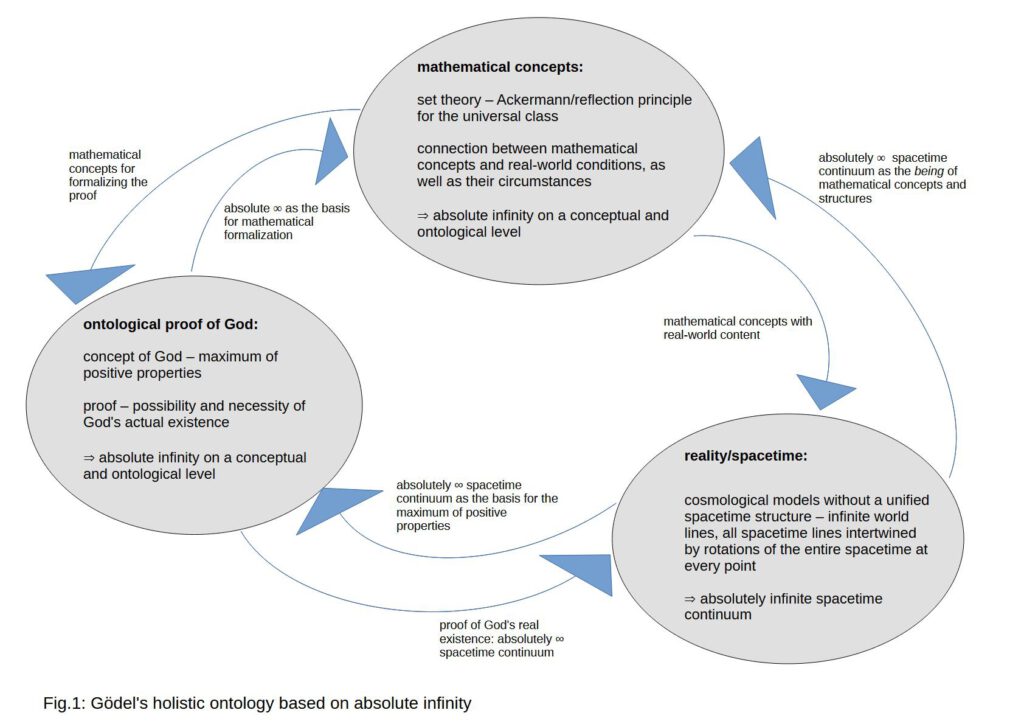
Absolute infinity thereby forms the core of all subsequent operations—in the mathematical concepts foundational to set theory, in the transference of mathematical concepts into reality through mathematically described cosmological models, and in the concept of God as the maximum of positive properties. If we bring together the results of the various domains of conceptual formation, space-time realization, and the ontological argument into a holistic worldview, this world is described in its essence as a maximally open, unrestricted relational fabric, grounded in the primordial monad of absolute infinity and containing free will within itself. World and mathematics belong together, as the mutual correspondence of conceptual intuition and spatiotemporal realization of absolute infinity.
References
Adams, R. M. (1995). Gödel *1970: Introductory note to *1970, by Robert M. Adams. In S. Feferman, J. John W. Dawson, W. Goldfarb, C. Parsons & R. M. Solovay (Eds.), Kurt Gödel: Collected Works Volume III: Unpublished Essays and Lectures (Vol. 3, pp. 388-402). New York: Oxford University Press.
Anderson, C. A. (1990). Some emendations of Gödel’s ontological proof. Faith and philosophy, 7(3), 291-303.
Anderson, C. A., & Gettings, M. (1996). Gödel’s ontological proof revisited Gödel’96: Logical foundations of mathematics, computer science and physics—Kurt Gödel’s legacy, Brno, Czech Republic, August 1996, proceedings (Vol. 6, pp. 167-173): Association for Symbolic Logic.
Barrow, J. D., & Tipler, F. J. (1986). The anthropic cosmological principle. New York: Oxford University Press.
Bedürftig, T., & Murawski, R. (2010). Philosophie der Mathematik. Berlin/New York: Walter de Gruyter.
Benzmüller, C. (2020). A (Simplified) Supreme Being Necessarily Exists, says the Computer: Computationally Explored Variants of Gödel’s Ontological Argument. Paper presented at the Proceedings of the International Conference on Principles of Knowledge Representation and Reasoning.
Benzmüller, C., & Fuenmayor, D. (2020). Computer-supported Analysis of Positive Properties, Ultrafilters and Modal Collapse in Variants of Gödel’s Ontological Argument. Bulletin of the Section of Logic, 49(2).
Benzmüller, C., & Paleo, B. W. (2014). Automating Gödel’s Ontological Proof of God’s Existence with Higher-order Automated Theorem Provers. Paper presented at the ECAI.
Bernays, P. (1937). A system of axiomatic set theory—Part I. The Journal of Symbolic Logic, 2(1), 65-77.
Bernays, P. (1976). A System of Axiomatic Set Theory. In G. H. Müller (Ed.), Sets and Classes on The Work by Paul Bernays (pp. 1-119). Amsterdam.
Burris, S., & Sankappanavar, H. P. (2012). A course in universal algebra. New York: Springer.
Canterbury, A. v. (1994). Proslogion. Stuttgart-Bad Cannstatt: Frommann-Holzboog Verlag.
Cantor, G. (1962). Mitteilungen zur Lehre vom Transfiniten. In E. Zermelo (Ed.), Gesammelte Abhandlungen mathematischen und philosophischen Inhalts. Berlin: Springer.
Cohen, P. J. (1963). The independence of the continuum hypothesis. Proceedings of the National Academy of Sciences, 50(6), 1143-1148.
Einstein, A. (1917). Kosmologische Betrachtungen zur Allgemeinen Relativitätstheorie. Sitzungsberichte der Königlich Preussischen Akademie der Wissenschaften, 142-152.
Ellis, G. F. R., & Hawking, S. W. (1973). The large scale structure of space-time. Cambridge, USA: Cambridge University Press.
Fitting, M. (2002). Types, tableaus, and Gödel’s god (Vol. 12): Springer Science & Business Media.
Gödel, K. (1929). Über die Vollständigkeit des Logikkalküls. In S. Feferman (Ed.), Kurt Gödel: Collected Works Vol. I (pp. 60-101). New York, Oxford: Oxford University Press.
Gödel, K. (1931). Über formal unentscheidbare Sätze der Principia Mathematica und verwandter Systeme I. Monatshefte für mathematik und physik, 38, 173-198.
Gödel, K. (1939). Consistency-proof for the generalized continuum-hypothesis. Proceedings of the National Academy of Sciences, 25(4), 220-224.
Gödel, K. (1940). The consistency of the axiom of choice and of the generalized continuum-hypothesis with the axioms of set theory: Princeton University Press.
Gödel, K. (1944). Russell’s mathematical logic. In S. Feferman (Ed.), Kurt Gödel. Collected Works Vol. II. New York Oxford: Oxford University Press.
Gödel, K. (1946). Remarks before the Princeton bicentennial conference on problems in mathematics. In S. Feferman (Ed.), Kurt Gödel. Collected Works Vol. II. New York, Oxford: Oxford University Press.
Gödel, K. (1947). What is Cantor’s continuum problem? The American Mathematical Monthly, 54(9), 515-525.
Gödel, K. (1949). An example of a new type of cosmological solutions of Einstein’s field equations of gravitation. Reviews of modern physics, 21(3), 447-450.
Gödel, K. (1949a). Remark about the relationship between relativity theory and idealistic philosophy. In S. Feferman (Ed.), Kurt Gödel. Collected Works Vol. II. 1990 (pp. 202-207). New York, Oxford: Oxford University Press.
Gödel, K. (1951). Some basic theorems on the foundations of mathematics and their implications. In S. Feferman (Ed.), Kurt Gödel: Collected Works Vol. III (pp. 304-323). New York, Oxford: Oxford University Press.
Gödel, K. (1952). Rotating universes in general relativity theory. In S. Feferman (Ed.), Kurt Gödel. Collected Works Vol. II. 1990 (pp. 208-2016). New York, Oxford: Oxford University Press.
Gödel, K. (1953). Is mathematics syntax of language? In S. Feferman (Ed.), Kurt Gödel. Collected Works Vol. III. New York, Oxford: Oxford University Press.
Gödel, K. (1961). The modern development of the foundations of mathematics in the light of philosophy. In S. Feferman (Ed.), Kurt Gödel: Collected Works Vol. III. New York, Oxford: Oxford University Press.
Gödel, K. (1970). Ontological Proof. In S. Feferman (Ed.), Kurt Gödel: Collected Works: Volume III: Unpublished Essays and Lectures. New York, Oxford: Oxford University Press.
Gödel, K. (1995a). Collected Works: Volume III: Unpublished Essays and Lectures (Vol. 3): Oxford University Press, USA.
Gödel, K. (1995b). Texts relating to the ontological proof. In S. Feferman (Ed.), Kurt Gödel: Collected Works Vol. III: Unpublished Essays and Lectures. New York, Oxford: Oxford University Press, USA.
Gödel, K. (2024). Maxims and Philosophical Remarks In G. Crocco, M. van Atten, P. Cantù & R. Rollinger (Eds.), Volume XIV of the Max Phil Notebooks. https://shs.hal.science/halshs-04533954v1.
Hájek, P. (2011). Gödel’s ontological proof and its variants. In M. Baaz, C. H. Papadimitriou, H. W. Putnam, D. S. Scott & J. Charles L. Harper (Eds.), Kurt Gödel and the Foundations of Mathematics (pp. 307-321). New York: Cambridge University Press.
Hawking, S. (1990). Introductory note to 1949 and 1952. In S. Feferman (Ed.), Kurt Gödel: Collected Works. Vol. II: Publications 1938-1974. New York, Oxford: Oxford University Press.
Hubble, E. (1929). A relation between distance and radial velocity among extra-galactic nebulae. Proceedings of the National Academy of Sciences, 15(3), 168-173.
Hubble, E. P. (1979). Cepheids in spiral nebulae A Source Book in Astronomy and Astrophysics, 1900–1975 (pp. 713-715): Harvard University Press.
Husserl, E. (1900). Logische Untersuchungen, Erster Teil: Prolegomena zur reinen Logik. Halle a. d. Saale: M. Niemeyer.
Husserl, E. (1988). Fünfte Logische Untersuchung. Hamburg: Meiner.
Husserl, E. (2006). Phantasie und Bildbewußtsein, Text nach Husserliana, Band XXIII. Hamburg: Felix Meiner.
Husserl, E. (2013). Zur phänomenologischen Reduktion: Texte aus dem Nachlass (1926–1935). Dordrecht: Springer.
Kovač, S. (2003). Some weakened Gödelian ontological systems. Journal of Philosophical Logic, 32(6), 565-588.
Kovač, S. (2012). Modal Collapse in Gödel’s Ontological Proof. Ontological Proofs Today, 50, 323-343.
Kovač, S. (2015). Causal interpretation of Gödel’s ontological proof. In K. Świętorzecka (Ed.), Gödel’s Ontological Argument: History, Modifications, and Controversies. Warszawa: Semper.
Kovač, S. (2020). On causality as the fundamental concept of Gödel’s philosophy. Synthese: An International Journal for Epistemology, Methodology and Philosophy of Science, 197(4), 1803-1838.
Leibniz, G. W. (1998). Monadologie. Stuttgart: Reclam.
Mühlenbeck, C. (2020). Die Unendlichkeit der Natur und der Einzeldinge – Husserls allseitig unendliches Erscheinungskontinuum und das Konzept des Kontinuums in der Philosophie der Mathematik. META: Research in Hermeneutics, Phenomenology and Practical Philosophy, XII(2), 249-283.
Mühlenbeck, C. (2021). Die absolute Unendlichkeit des Raumzeit-Kontinuums als grundlegende Fundamentalontologie. META: Research in Hermeneutics, Phenomenology, and Practical Philosophy., XIII(2), 343-366.
Mühlenbeck, C. (2022a). The Fundamental Ontology of Developmental Psychology: The Development of the Self as a Systematic Relationship between the Concept of the World and the Concept of the Self in Orientation towards Absolute Infinity. META: Research in Hermeneutics, Phenomenology, and Practical Philosophy, XIV(2), 383-401.
Mühlenbeck, C. (2022b). The orientation on absolute infinity and the openness of worldviews as the necessary foundation for models of developmental psychology. META: Research in Hermeneutics, Phenomenology, and Practical Philosophy., XIV(1), 201-223.
Mühlenbeck, C. (2024). Der Zusammenhang zwischen Gödels Unvollständigkeitssätzen, der Kontinuumshypothese und dem Ontologischen Gottesbeweis auf seine Auswirkungen auf die metamathematische Grundlegung der Mathematik. Freie Universität Berlin, Berlin. Retrieved from http://dx.doi.org/10.17169/refubium-43924
Mühlenbeck, C., & Benzmüller, C. (2024 submitted). On the maximality of positive properties and modal collapse in variants of Gödel’s ontological proof of God. Logic and Logical Philosophy.
Mühlenbeck, C., & Jacobsen, T. (2020). On the origin of visual symbols. Journal of Comparative Psychology, 134(4), 435. doi: 10.1037/com0000229
Mühlenbeck, C., Jacobsen, T., Pritsch, C., & Liebal, K. (2017). Cultural and species differences in gazing patterns for marked and decorated objects: A comparative eye-tracking study. Frontiers in Psychology, 8. doi: 10.3389/fpsyg.2017.00006
Mühlenbeck, C., Liebal, K., Pritsch, C., & Jacobsen, T. (2015). Gaze duration biases for colours in combination with dissonant and consonant sounds: A comparative eye-tracking study with orangutans. PloS One, 10(10), e0139894. doi: 10.1371/journal.pone.0139894
Mühlenbeck, C., Liebal, K., Pritsch, C., & Jacobsen, T. (2016). Differences in the visual perception of symmetric patterns in orangutans (Pongo pygmaeus abelii) and two human cultural groups: A comparative eye-tracking study. Frontiers in Psychology, 7. doi: 10.3389/fpsyg.2016.00408
Neumann, J. v. (1925). Eine Axiomatisierung der Mengenlehre. Journal für reine u. angewandthe Mathematik, 154, 219-240.
Neumann, J. v. (1928). Die Axiomatisierung der Mengenlehre. Mathematische Zeitschrift, 27, 669-752.
Rucker, R. (2019). Infinity and the mind: The science and philosophy of the infinite. Princeton, New Jersey: Princeton University Press.
Sala, G. B. (1990). Kant und die Frage nach Gott: Gottesbeweise und Gottesbeweiskritik in den Schriften Kants. Berlin, New York: Walter de Gruyter.
Scott, D. (1972). Appx. B: notes in Dana Scott’s Hand Logic and Theism: Arguments for and against Beliefs in God (pp. 145-146): Cambridge University Press.
Shapley, H., & Curtis, H. D. (1979). The scale of the universe A Source Book in Astronomy and Astrophysics, 1900–1975 (pp. 523-541): Harvard University Press.
Sobel, J. H. (1987). Gödel’s ontological proof. In J. J. Thomson (Ed.), On being and saying. Essays for Richard Cartwright (pp. 241-261). Cambridge, Mass.: The MIT Press.
Sobel, J. H. (2004). Logic and Theism: Arguments for and against Beliefs in God: Cambridge University Press.
Świętorzecka, K. (2015). Gödel’s Ontological Argument: History, Modifications, and Controversies. Warsaw: Semper.
Wang, H. (1974). From Mathematics to Philosophy. New York: Humanities Press.
Wang, H. (1997). A logical journey: From Gödel to philosophy. Cambridge, MA: MIT press.
Wikipedia-Autoren. (2023, Bearbeitungsstand: 8. November 2023, 20:26 UTC). „Gödel- Universum“. In: Wikipedia – Die freie Enzyklopädie Retrieved 19. Februar 2025, 05:10 UTC, from https://de.wikipedia.org/w/index.php?title=G%C3%B6del-Universum&oldid=238935557
Yourgrau, P. (1999). Gödel meets Einstein: Time travel in the Gödel universe. Chicago: Open Court.
Yourgrau, P. (2005). A world without time: The forgotten legacy of Gödel and Einstein. New York: Basic Books.
Yourgrau, P. (2023). Gödel’s Temporal Idealism: A Reply to Prof. Kahle. In O. Passon, C. Benzmüller & B. Falkenburg (Eds.), On Gödel and the Nonexistence of Time–Gödel und die Nichtexistenz der Zeit: Kurt Gödel essay competition 2021–Kurt-Gödel-Preis 2021 (pp. 37-50). Berlin: Springer.
- As for the current situation concerning the foundations of mathematics, he describes in (Gödel, 1995a, p. 50): „The result of the preceding discussion is that our axioms, if interpreted as meaningful statements, necessarily presuppose a kind of Platonism, which cannot satisfy any critical mind and which does not even produce the conviction that they are consistent.“ ↩︎
- These different levels of concepts, which are also connected with the results of Gödel’s incompleteness theorems, have implications for the human–machine relationship (Barrow & Tipler, 1986, p. 155; Rucker, 2019, chap. 4), since the non-finalizability of formalization is characteristic of computer-based computation, whereas human consciousness is capable of grasping holistic concepts and discovering true statements where formalization fails (Richard’s Paradox, described in: Gödel, 1931). In a computer, a comprehensive concept could be defined and used, but this concept would have to be formed at the axiomatic level and cannot be obtained through formalization. ↩︎
- For example, axioms asserting the existence of inaccessible numbers (and inaccessible cardinal numbers) > ℵ0 (Bedürftig & Murawski, 2010, p. 225). ↩︎
- Cantor’s theorem already showed that the universal class, as the system of all classes, cannot be a set (the second Cantorian antinomy), because otherwise the power set of the universal class would have to be one of its subsets and therefore could not be of strictly greater cardinality. ↩︎
- In contemporary mathematics, the concept of the continuum is identified with ℝ (Bedürftig & Murawski, 2010, p. 186). Cantor already recognized the distinction between the relevant notions, but he regarded what is here referred to as the homogeneous continuum as an “inconsistent multiplicity” (Wang, 1997, p. 261). We continue to use the term “homogeneous” here, since discrete points—with their inherent limitations and actual dividedness—introduce inhomogeneity and thereby inconsistency, whereas the infinite divisibility of absolute infinity constitutes a fluid homogeneity and no inconsistency, because infinite divisibility is a property of intuition, in contrast to the infinite division inherent in the discrete. ↩︎
- Cantor’s descriptions of absolute infinity can be found in (Cantor, 1962). ↩︎
- It should be emphasized that the connection between the Ackermann principle and V is a novel conceptual linkage and need not hold for every set-theoretic universe sufficient for present mathematical practice, since set systems may operate with fewer axioms and degrees of infinity, as illustrated by Gödel’s inner model of constructible sets in his proof of the continuum hypothesis (Gödel, 1939). ↩︎
- The term “pure attributions” refers to the disjunctive normal form of elementary properties, i.e., properties that involve an element without negation (Gödel, 1970, p. 404). ↩︎